

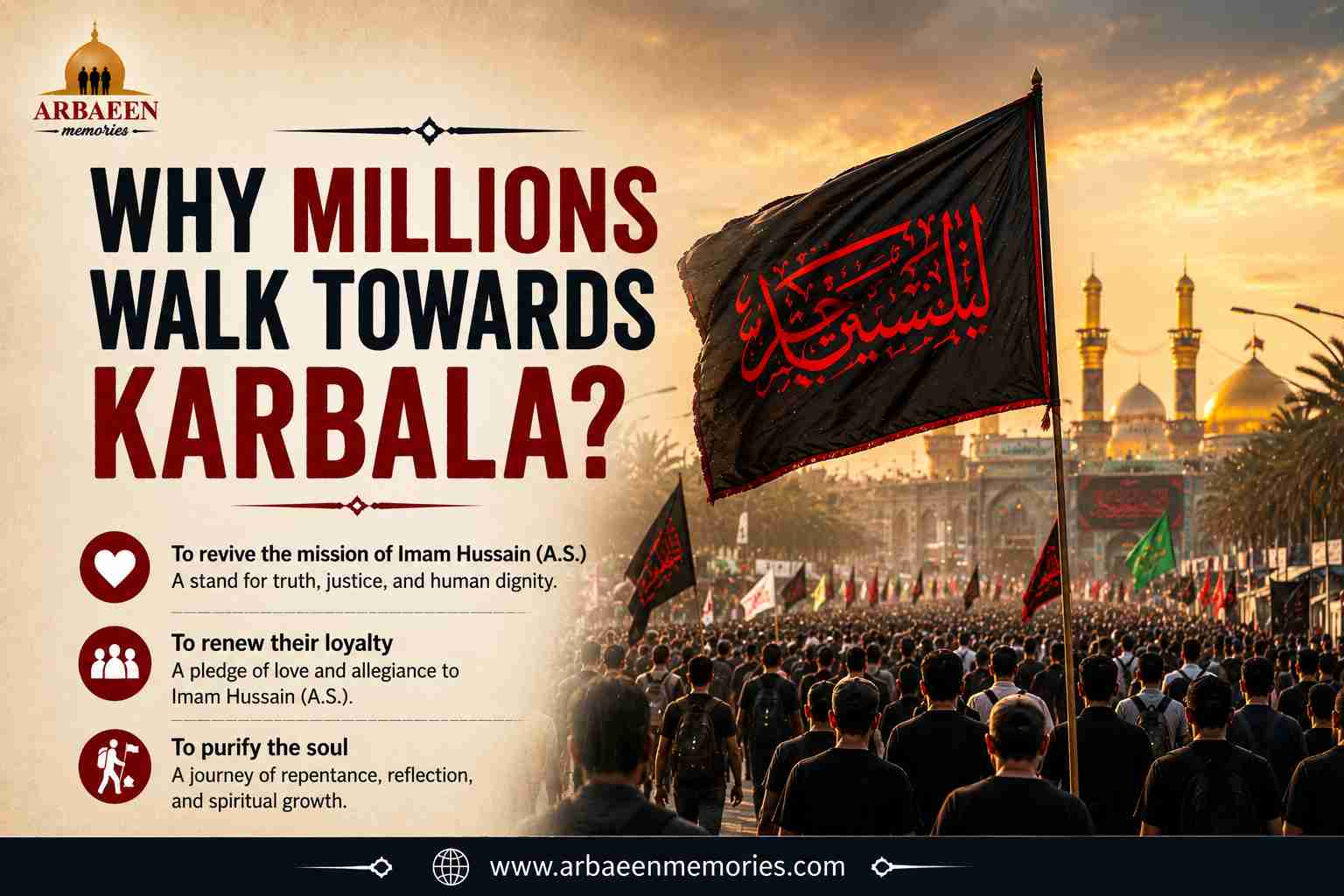
Every year, millions of people from around the world travel to Iraq and walk toward the holy city of Karbala during Arbaeen. For many outside the Muslim world, the question is simple: Why do millions of people willingly walk for days, sometimes hundreds of kilometers, to reach one city?
The answer lies in the enduring message of Imam Hussain (A.S.), the grandson of Prophet Muhammad (PBUH), whose sacrifice in Karbala over 1,400 years ago continues to inspire people across generations.
The Historical Significance of Karbala
In the year 680 CE, Imam Hussain (A.S.) refused to pledge allegiance to a ruler he believed represented injustice and corruption. Despite knowing the dangers ahead, he chose to stand for truth, justice, and human dignity.
Along with his family and a small group of companions, he faced an army many times larger than his own. On the 10th of Muharram, known as Ashura, Imam Hussain (A.S.) and his companions were martyred, while the women and children of his family were taken captive.
For millions of believers, Karbala is not merely a historical event. It is a timeless lesson that teaches humanity never to surrender to oppression and never to compromise principles for worldly gain.
Every step toward Karbala is a declaration of loyalty to those values.
Why Pilgrims Walk During Arbaeen
The Arbaeen walk is an expression of love and remembrance. Pilgrims walk to honor the sacrifices made by Imam Hussain (A.S.), his family, and his companions.
They walk because they believe that the message of Karbala remains relevant in every age where injustice, oppression, and corruption exist.
But Arbaeen is about more than mourning. It is also about transformation.
The journey teaches patience, humility, gratitude, and self-discipline. Walking long distances under the sun reminds pilgrims of sacrifice and encourages reflection on their own lives and responsibilities.
The Spirit of Service During Arbaeen
One of the most remarkable aspects of the pilgrimage is the spirit of service. Along the roads leading to Karbala, thousands of mawakeb provide food, water, accommodation, medical assistance, and transportation free of charge.
Volunteers serve pilgrims day and night purely out of love for Imam Hussain (A.S.). This extraordinary generosity creates a unique atmosphere where compassion and selflessness become the norm.
A Journey of Unity and Brotherhood
People from every background participate in the walk. Rich and poor, young and old, Arab and non-Arab, all travel the same roads and share the same purpose.
Nationality, language, and social status become secondary to a shared devotion. The journey becomes a living example of unity and brotherhood.
For many believers, the walk also represents a renewal of their commitment to justice and humanity. Karbala teaches that faith is not merely words or rituals; it requires standing for what is right even when it is difficult.
The pilgrimage reminds participants to carry these values into their daily lives.
Arbaeen and the Awaited Future
Many also see Arbaeen as preparation for the reappearance of Imam Mahdi (A.J.). The unity, sacrifice, service, and devotion displayed during the pilgrimage reflect the qualities believers hope to embody while awaiting a future filled with justice and peace.
In a world often divided by politics, race, and conflict, the Arbaeen pilgrimage offers a powerful alternative vision. It demonstrates how millions can come together peacefully around shared values of faith, compassion, and justice.
So Why Do Millions Walk to Karbala?
They walk for love.
They walk for remembrance.
They walk for justice.
They walk because the message of Imam Hussain (A.S.) is as relevant today as it was on the day of Ashura.
And with every step, they proclaim that the sacrifice of Karbala will never be forgotten.