

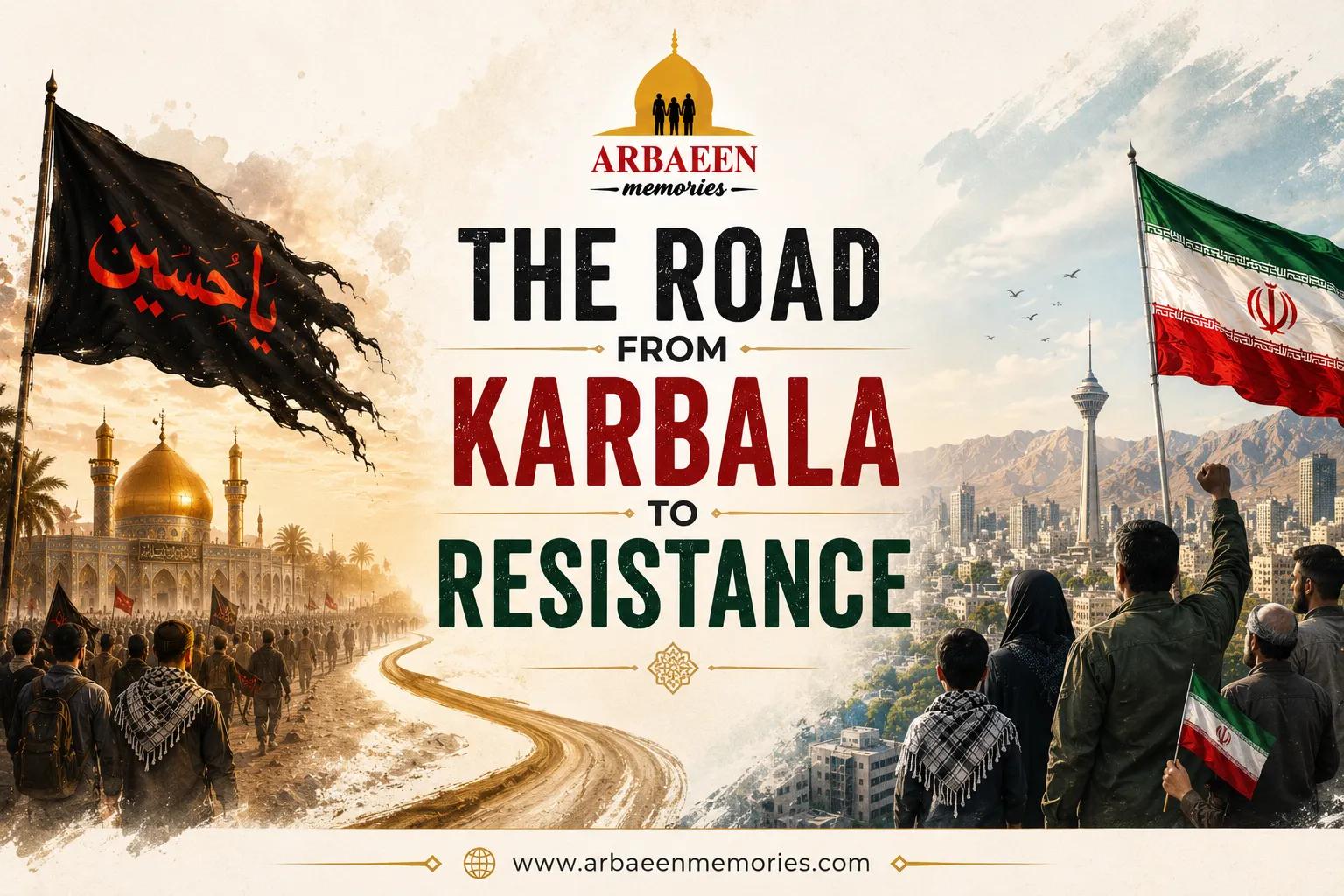
The Road from Karbala to Resistance
Every movement has a beginning. Every revolution has a source. For millions across the world, the road of resistance did not begin in modern politics, military conflicts, or national struggles. Its roots stretch back more than fourteen centuries to a desert called Karbala.
The Beginning of a Timeless Struggle
On the 10th of Muharram in the year 680 CE, Imam Hussain (A.S.), the grandson of Prophet Muhammad (PBUH), faced an army many times larger than his own. He knew the outcome of the battle before it began. Yet he refused to compromise with injustice or surrender to tyranny.
Karbala was not a battle for power. It was a stand for truth.
That single act of sacrifice changed history.
The enemies of Imam Hussain (A.S.) believed that by eliminating him, they could silence his message forever. Instead, Karbala became a beacon that continues to inspire people centuries later. His blood watered the tree of resistance, and its branches continue to spread across generations.
The Principles of Resistance
The road from Karbala to resistance is not a road marked by geography. It is a road marked by principles.
It begins with the belief that oppression should never be accepted as normal. It teaches that dignity is more valuable than comfort and that standing for truth is more important than personal safety.
Arbaeen: A Renewal of the Pledge
Every year, millions walk to Karbala during Arbaeen. To many observers, it appears to be a religious pilgrimage. But for those who understand its deeper meaning, it is also a renewal of a pledge.
A pledge that the values of Karbala will never be forgotten.
When pilgrims walk towards the shrine of Imam Hussain (A.S.), they are not only remembering a historical event. They are connecting themselves to a living message. They are declaring that the struggle between justice and oppression did not end in the seventh century. It continues in every age and every generation.
Why Karbala Inspires Resistance
This is why Karbala continues to inspire movements of resistance around the world. The lesson is simple but powerful:
- Numbers do not determine truth.
- Weapons do not determine righteousness.
- Power does not determine justice.
Imam Hussain (A.S.) stood with only a handful of companions, yet his message reached millions. His enemies possessed armies, wealth, and authority, yet their power faded with time.
Karbala teaches that:
- Moral strength can outlive military strength.
- Sacrifice can achieve what force cannot.
Resistance as a Spiritual Responsibility
For many believers, resistance is therefore not merely a political concept. It is a spiritual responsibility.
It means:
- Refusing to surrender one’s principles in the face of pressure.
- Standing beside the oppressed.
- Defending justice.
- Preserving human dignity.
The road from Karbala has passed through many chapters of history. It has inspired scholars, reformers, freedom movements, and ordinary people who refused to accept injustice. Different nations and communities may express that spirit in different ways, but the source remains the same.
The Heart of Resistance
At its heart, resistance is not about hatred. It is about courage.
- It is not about revenge. It is about justice.
- It is not about domination. It is about dignity.
That is why the story of Karbala continues to resonate today. The road that began with Imam Hussain (A.S.) did not end on Ashura. It continues wherever people choose truth over fear and principles over submission.
A Journey That Continues
The road from Karbala to resistance is still being traveled.
And with every generation, new footsteps join the journey.