

Throughout history, nations have measured power through armies, economies, warships, and weapons. Empires rose believing they would rule forever. Superpowers emerged thinking their influence could never be challenged. Yet history teaches a different lesson: every worldly power has limits.
The Holy Quran reminds us:
“And to Allah (SWT) belong the soldiers of the heavens and the earth.” (Quran 48:4)
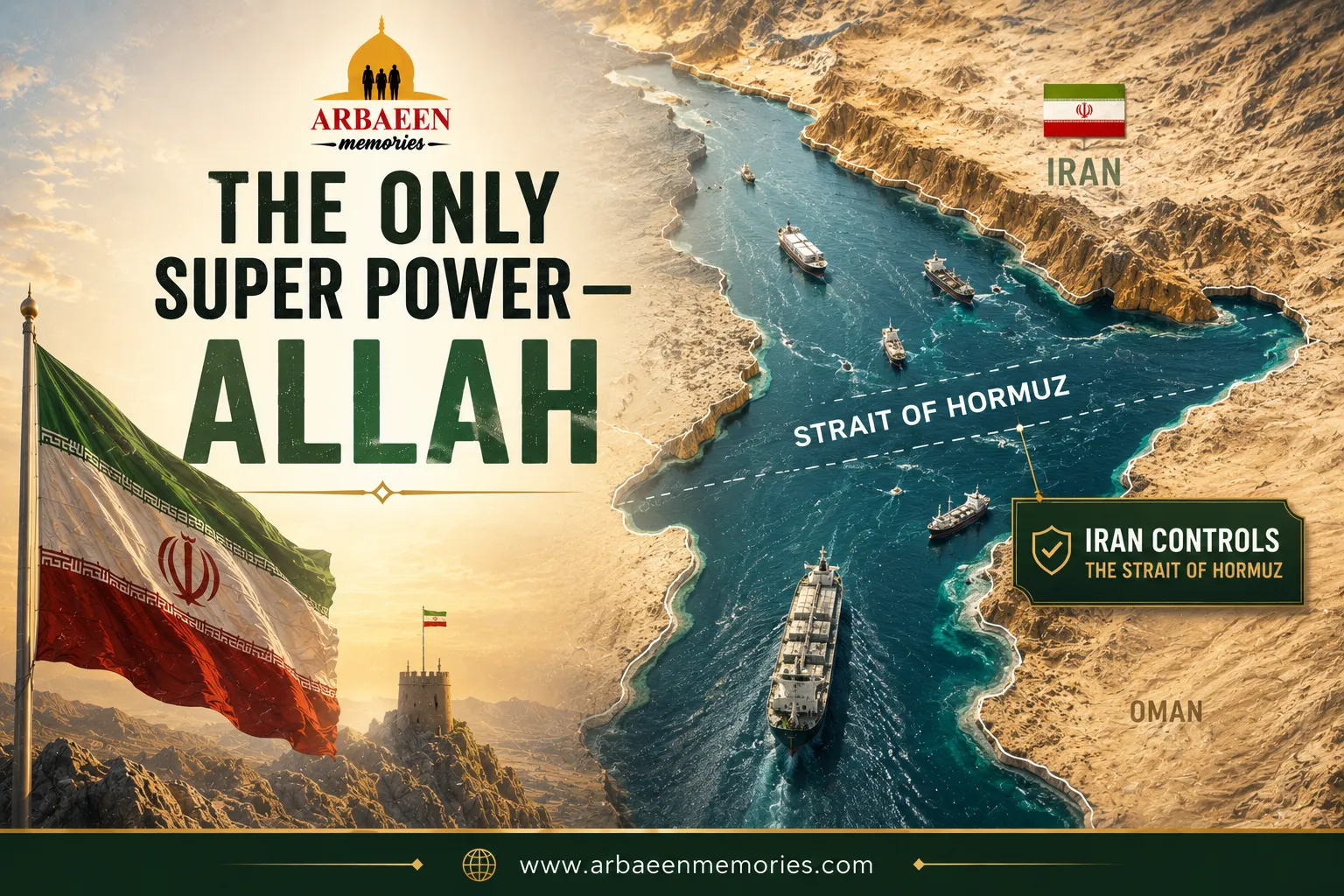
Recent events surrounding the Strait of Hormuz once again demonstrated how fragile human assumptions about power can be. The Strait of Hormuz is one of the world’s most strategic waterways, carrying roughly one-fifth of global oil and energy supplies. It is widely regarded as the most important energy chokepoint on Earth.
Located between Iran and Oman, the strait connects the Persian Gulf to the rest of the world. The geography of the region gives Iran significant influence over one of the most critical maritime corridors in modern history.
When tensions escalated, the world witnessed how a narrow waterway could affect global markets, oil prices, shipping routes, and international politics. Governments, corporations, and financial markets suddenly realized how quickly the balance of power could shift when a strategic chokepoint became uncertain. Around 20% of global oil and LNG trade passes through this corridor, making it vital to the world economy.
Yet the deeper lesson goes beyond geography and politics.
For many supporters of the Islamic Revolution, the significance of these events was not that Iran is a superpower. Rather, they argue that the real source of strength lies elsewhere. Nations may possess strategic advantages, military capabilities, and economic resources, but none of these are permanent.
The Islamic worldview teaches that victory, power, and authority ultimately belong to Allah (SWT) alone.
Iran’s supporters often point to decades of sanctions, pressure, isolation, threats, and conflict. Despite these challenges, they believe that resilience came not merely from technology or military preparation but from faith, sacrifice, and trust in Allah (SWT).
This lesson is deeply rooted in Islamic history.
At Badr, a small Muslim force faced a much larger army.
At Khandaq, Imam Ali (A.S.) stood against overwhelming odds.
At Karbala, Imam Hussain (A.S.) and his companions chose dignity over submission despite facing certain martyrdom.
In each case, believers learned that material strength alone does not determine outcomes. True strength comes from faith, conviction, and reliance upon Allah (SWT).
That is why the story of the Strait of Hormuz carries a symbolic meaning for many believers. A strategic waterway can influence global markets. A nation can influence a region. A military can influence a battlefield.
But only Allah (SWT) controls destiny.
Empires rise and fall.
Superpowers emerge and decline.
Weapons are built and destroyed.
But the power of Allah (SWT) remains eternal.
The real lesson is not that one nation became stronger than another. The lesson is that the balance of worldly power can change at any moment, reminding humanity that ultimate authority belongs to none but Allah (SWT).
The Only Super Power is Allah (SWT).
Nations may possess strength.
People may possess determination.
Resistance may possess courage.
But every victory, every opportunity, and every source of power ultimately comes from Him alone.
And that truth remains unchanged throughout history.