

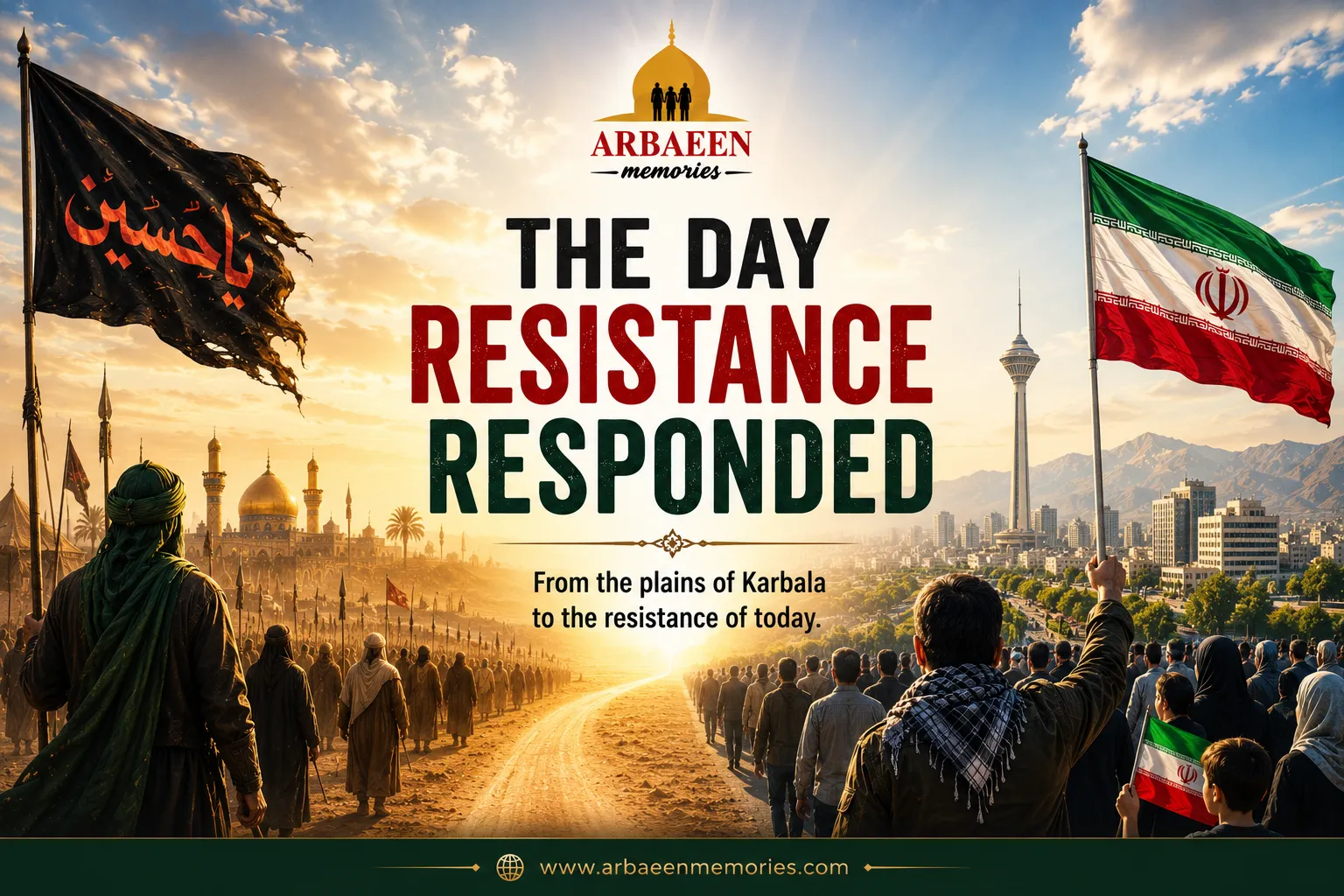
Many people think resistance began in modern battlefields, political movements, or regional conflicts. They often associate it with Palestine, Lebanon, Iraq, Yemen, or Iran.
However, for millions across the world, the story of resistance began long before modern borders existed.
The Beginning of Resistance: Karbala
It began on the plains of Karbala.
In the year 680 CE, Imam Hussain (A.S.), the grandson of Prophet Muhammad (PBUH), stood against the rule of Yazid. This struggle was not a battle for territory, wealth, or political power. Instead, it was a stand against injustice, oppression, and the corruption of moral values.
Despite facing overwhelming military force, Imam Hussain (A.S.) refused to surrender his principles.
On Ashura, he and his small group of companions were martyred. Yet Karbala proved a timeless truth: a movement based on truth can survive even when its defenders fall.
For Shia Muslims, and for many others inspired by Karbala, Imam Hussain (A.S.) became the eternal symbol of resistance against tyranny. His sacrifice transformed Karbala from a historical event into a living message that continues across generations.
Scholars have noted that the martyrdom of Imam Hussain has long been interpreted as a symbol of resistance against oppression and injustice.
Why the Language of Karbala Endures
For this reason, the language of Karbala continues to appear whenever people speak about dignity, sacrifice, and standing firm under pressure.
Whether in Palestine, Lebanon, Iraq, Yemen, or elsewhere, many people draw inspiration from the belief that oppression should never be accepted as normal. They also believe that silence in the face of injustice carries its own consequences.
Therefore, resistance is not merely a military concept. It is a moral principle.
It is the refusal to abandon justice because the opponent is stronger.
It is the refusal to compromise truth because pressure becomes unbearable.
It is the refusal to surrender dignity in exchange for comfort.
The Moral Principle of Resistance
Throughout history, powerful empires have relied on military superiority to enforce their will. However, Karbala teaches that the strongest force is not always the largest army.
Sometimes, it is the conviction of those who believe they are standing on the side of truth.
This is why millions walk to Karbala every year. They walk to renew their commitment to the values that Imam Hussain (A.S.) defended: justice, courage, sacrifice, and faith.
Arbaeen and Ashura continue to symbolize resistance against tyranny for millions of believers around the world.
The Day the Resistance Responded
The Day the Resistance Responded is not the story of a missile launch, a military operation, or a political event.
Rather, it is the story of a response that began in Karbala more than fourteen centuries ago.
A response to injustice.
A response to oppression.
A response to the belief that truth should never be abandoned, no matter how powerful the opposition may appear.
From Karbala to the present day, the message remains unchanged:
Power may command armies.
Power may control wealth.
Power may dominate headlines.
But the spirit of resistance lives wherever people refuse to bow before injustice.
And that spirit began with Imam Hussain (A.S.).