

History has shown that movements built upon faith, sacrifice, and conviction rarely remain confined to one place. When a person stands for a cause they believe is just, their message often inspires others far beyond their borders.
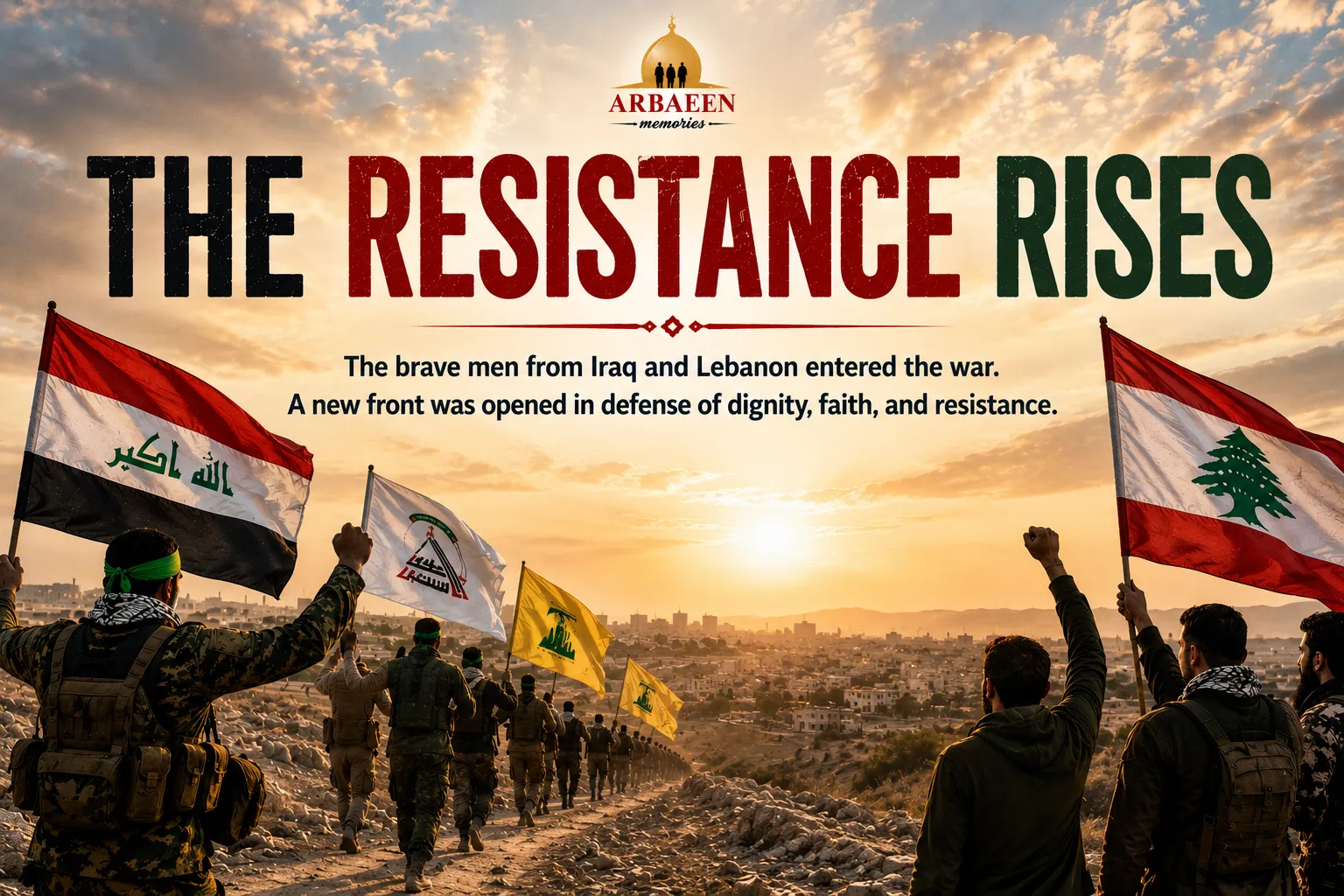
As the conflict intensified, fighters and supporters from Iraq and Lebanon declared their support and entered the struggle. What had begun as a confrontation involving one nation soon evolved into a broader movement united by a shared belief in dignity, resistance, and standing against what they viewed as oppression.
The Legacy of Karbala
For many across the region, this was not simply a political or military development. Many people saw it as the continuation of a historical path that stretches back to Karbala. The message of Imam Hussain (A.S.) taught generations that silence in the face of injustice is not an option. His stand against tyranny became a source of inspiration for countless people who believe that dignity is worth defending, regardless of the challenges.
Solidarity from Iraq and Lebanon
Supporters viewed the entry of resistance groups and volunteers from Iraq and Lebanon as a demonstration of solidarity. A common belief united people from different languages, cultures, and nationalities. These principles included loyalty, sacrifice, faith, and the defense of the oppressed.
The spirit of resistance has deep roots in both Iraq and Lebanon. Iraq is home to the holy shrines of Karbala and Najaf, where millions gather every year to renew their connection with the message of Imam Hussain (A.S.). Lebanon, too, has witnessed generations of people who view resistance not merely as a military concept but as a commitment to preserving dignity and independence.
Faith Stronger Than Fear
As the conflict expanded, supporters argued that a new front had opened—not only on the battlefield, but in the hearts and minds of those who believed that faith should be stronger than fear. They saw themselves as continuing a tradition that values sacrifice over submission and perseverance over surrender.
Many supporters did not measure the significance of this moment by military calculations alone. Instead, they measured it by the willingness of people to stand together despite differences in nationality and geography. The idea that believers from different nations could unite around common values became a powerful symbol of solidarity.
The Lesson of Karbala
Supporters frequently pointed to the lesson of Karbala: true strength is not determined by numbers, wealth, or military power. Rather, conviction and trust in Allah (SWT) provide that strength. The companions of Imam Hussain (A.S.) were few in number, yet their sacrifice changed history. This lesson continues to inspire those who believe that faith can overcome even the greatest challenges.
The Resistance Rises
The Resistance Rises is therefore more than a story of armed groups entering a conflict. It is the story of a shared belief that dignity should be protected, injustice should be challenged, and principles should not be abandoned under pressure.
For supporters, the rise of resistance represents the rise of unity, courage, and determination. It reflects the belief that borders may divide nations, but faith and conviction can unite hearts.
A Message That Endures
As new chapters continue to unfold, many see the same message that began in Karbala centuries ago:
That truth cannot be defeated by numbers.
That faith cannot be broken by fear.
And that the spirit of resistance continues to rise wherever people stand for dignity, justice, and belief.