

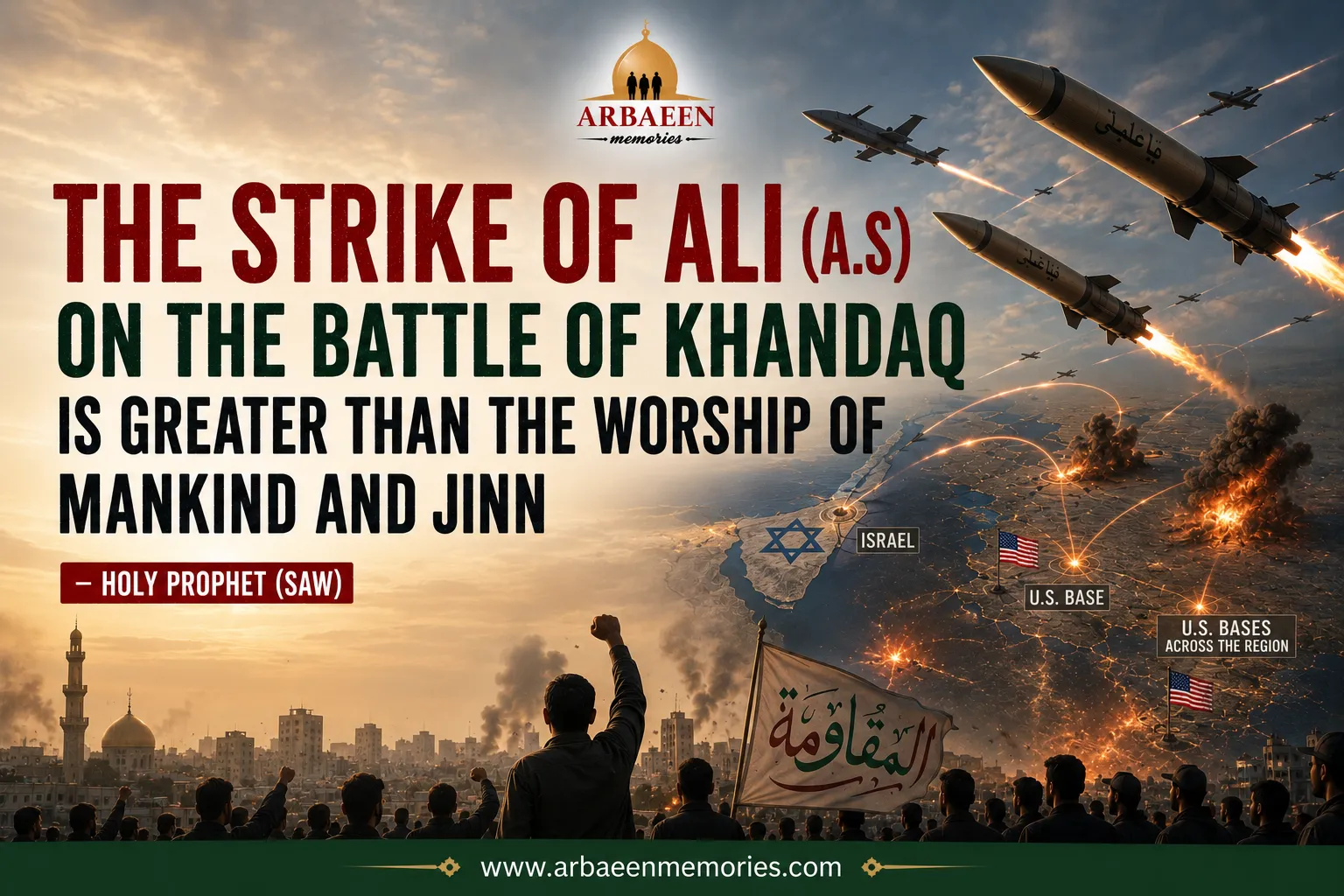
Among the most famous sayings attributed to the Holy Prophet (PBUH) is:
“The strike of Ali on the Day of Khandaq is superior to the worship of mankind and jinn.”
Whether discussed in classical Shia scholarship or debated among scholars regarding its chains of transmission, the meaning behind this statement has inspired generations of believers.
To understand its significance, one must first understand the Battle of Khandaq.
The Battle of Khandaq
The Muslim community in Madinah faced an existential threat. Thousands of enemy fighters had gathered to destroy Islam once and for all.
During the battle, the renowned warrior Amr ibn Abd Wudd crossed the trench and challenged the Muslims. As a result, fear spread through the ranks. Few were willing to face him.
At that moment, Imam Ali (A.S.) stepped forward.
His strike was not merely the defeat of a warrior. Rather, it protected the entire Muslim community at one of the most critical moments in Islamic history.
Had the enemy succeeded, the future of Islam itself could have been placed in danger. Therefore, the strike of Imam Ali (A.S.) was viewed as more than a military action. It was a defense of truth, faith, and the mission of Islam.
The lesson of Khandaq is clear. The value of an action is not measured by its physical size. Instead, it is measured by what it protects and what it represents.
The Lesson for Modern Times
This lesson continues to resonate today.
When supporters of the Islamic Resistance look at modern confrontations involving Iran, they often view them through the lens of Khandaq.
They do not see missiles merely as weapons. Nor do they see military operations merely as acts of war. Instead, they see a nation attempting to defend its sovereignty, dignity, and beliefs in the face of overwhelming pressure.
For them, the significance lies not in the missile itself but in the intention behind it.
Likewise, Imam Ali’s strike at Khandaq is not remembered because of the sword alone. In the same way, modern acts of resistance are not remembered because of technology. They are remembered because they represent a refusal to surrender when facing overwhelming power.
Faith as the Real Source of Strength
However, the deeper lesson is even greater.
The victory at Khandaq was not ultimately attributed to the sword of Imam Ali (A.S.) alone. Rather, it was attributed to faith, sincerity, and reliance upon Allah (SWT).
The sword was merely the instrument. The real force behind the victory was belief.
The same principle is often invoked by those who support Iran’s position today.
They argue that Iran’s strength does not come primarily from missiles, drones, military bases, or technology. These are only tools.
Instead, they believe that the true source of strength is faith. They hold that Allah (SWT) is the ultimate source of power and that dignity cannot be purchased through submission.
The Holy Quran reminds believers:
“And victory is not except from Allah (SWT), the Almighty, the Wise.” (Quran 3:126)
The Connection Between Khandaq and the Present
This is the connection between Khandaq and the present.
At Khandaq, one strike changed history because it was performed for Allah (SWT) and in defense of truth.
Today, supporters of resistance movements believe that their strength comes not from weapons but from the same spirit of faith, sacrifice, and steadfastness that inspired Imam Ali (A.S.).
The lesson of Khandaq was never about the sword.
It was about conviction.
It was about standing firm when others hesitated.
It was about trusting Allah (SWT) when the odds seemed impossible.
For this reason, the strike of Ali (A.S.) continues to inspire believers centuries later. It reminds them that faith is stronger than fear and that truth is stronger than power.