

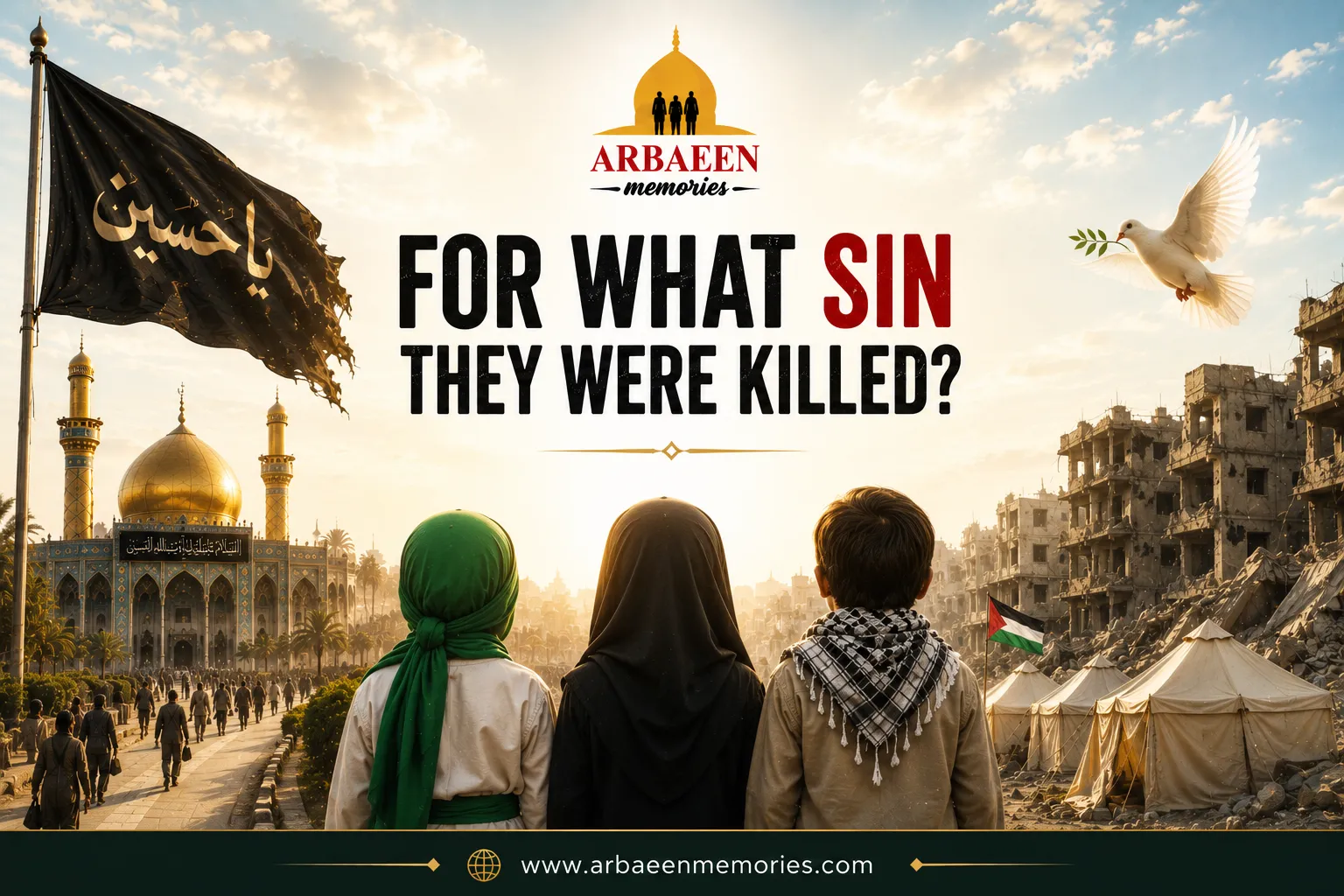
It is a question addressed to humanity itself. A question that confronts every conscience whenever innocent lives are lost.
It is a question that was asked in Karbala more than 1,400 years ago, and it remains relevant today.
The Tragedy of Ali Asghar (A.S.)
In Karbala, among the martyrs was a six-month-old infant — Imam Ali Asghar (A.S.).
He carried no sword. He posed no threat. He had committed no crime.
According to Islamic tradition, Imam Hussain (A.S.) carried his thirsty infant before the opposing army and asked only for water. Instead, the child was struck by an arrow and martyred.
The tragedy of Ali Asghar (A.S.) has become one of the most powerful symbols of innocence in Islamic history. Whenever believers remember Karbala, they remember not only the courage of Imam Hussain (A.S.) but also the suffering of a child whose only “crime” was being born into a family that stood for truth.
A Question That Still Echoes Today
Today, the question of Karbala continues to echo:
- For what sin are children killed in Gaza?
- For what sin do children in war zones lose their homes, families, schools, and futures?
- For what sin do children in Yemen suffer hunger, disease, and displacement?
- For what sin have generations of children in Iraq and Syria grown up surrounded by conflict and destruction?
- For what sin have children in Lebanon and Iran become victims of violence, fear, and war?
The Humanitarian Cost of Conflict
Humanitarian organizations continue to report immense suffering among children across the Middle East.
In Gaza alone, tens of thousands of children have been reported killed, injured, displaced, or otherwise affected by the conflict. UNICEF and other agencies have repeatedly warned that children are paying the highest price in ongoing wars.
Across the wider region, UNICEF reports that thousands of children have been killed or injured amid escalating conflicts affecting Palestine, Lebanon, Iran, and neighboring countries.
The tragedy is not limited to one nation or one people. It is a humanitarian wound that crosses borders and generations.
The Lesson of Karbala
The story of Ali Asghar (A.S.) teaches an important lesson.
Karbala was never only about the past. It was meant to awaken human conscience. When believers mourn Ali Asghar (A.S.), they are reminded of:
- Every innocent child whose voice is never heard.
- Every child who becomes a victim of decisions made by adults.
- Every child whose future is stolen by war.
Imam Hussain (A.S.) stood against oppression so that humanity would never become indifferent to injustice. His message calls upon people to defend the dignity of the vulnerable and to remember those who cannot defend themselves.
The Unanswered Question
The children of Gaza, Yemen, Iraq, Syria, Lebanon, Iran, and every conflict zone remind us that the question of Karbala remains unanswered.
- For what sin were they killed?
- For what crime were they deprived of safety, family, and hope?
The answer is the same today as it was in Karbala:
- They committed no crime.
- They carried no weapon.
- They sought no power.
- They were innocent.
And it is the responsibility of humanity to ensure that their suffering is neither forgotten nor ignored.
A Cry That Still Echoes
Because every child lost to war is a reminder that the cry of Ali Asghar (A.S.) still echoes across the world.