

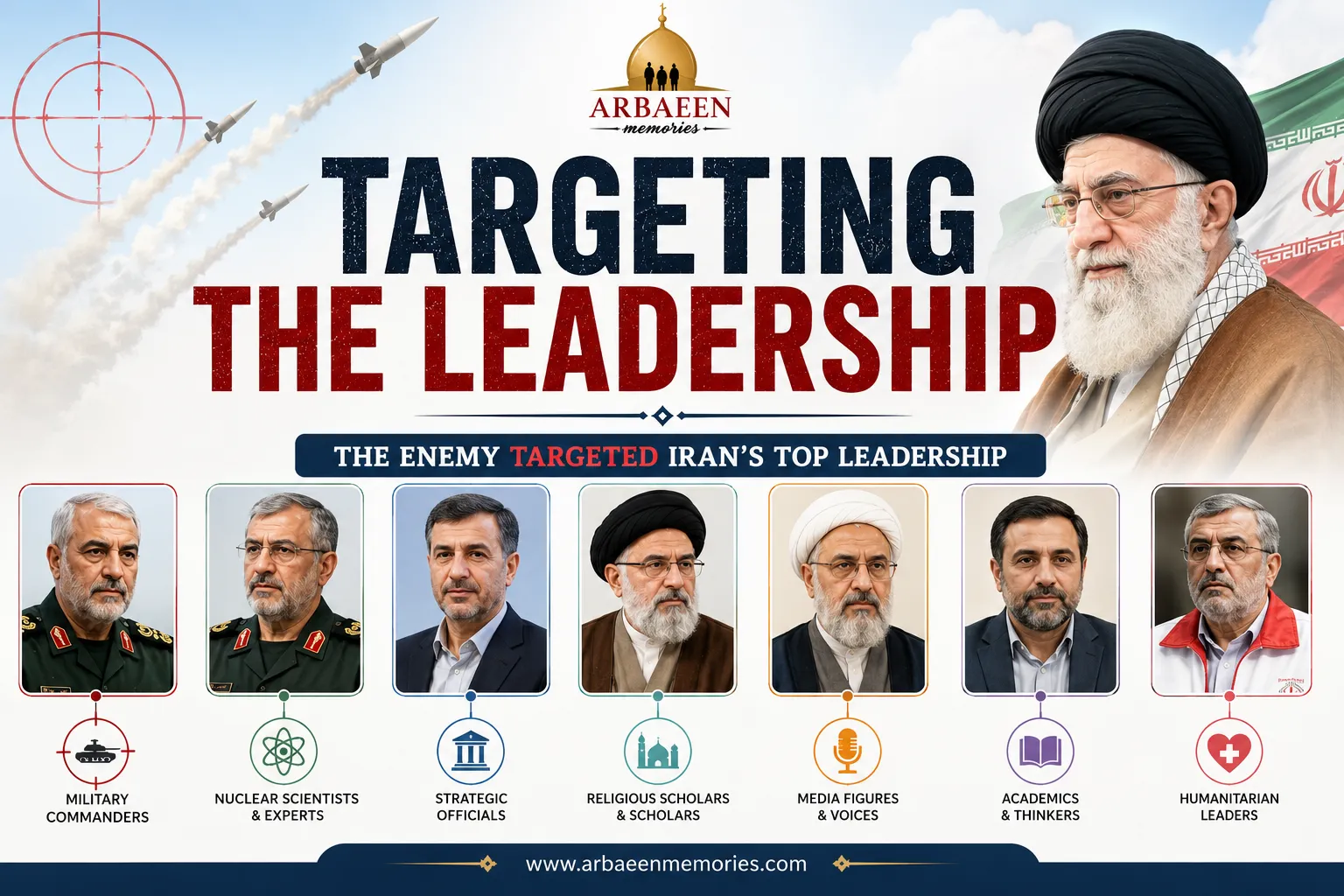
Throughout history, those seeking to weaken a movement have often followed the same strategy: target its leadership.
The assumption is simple:
- Remove the leaders.
- The movement will collapse.
From ancient empires to modern conflicts, powerful forces have repeatedly believed that eliminating key figures would silence opposition and bring resistance to an end.
Yet history tells a different story.
When Leaders Fall, Ideas Remain
Many of the world’s most influential movements did not disappear when their leaders were targeted.
In many cases:
- Their ideas survived.
- Their influence expanded.
- Their followers became more committed.
The loss of a leader often transformed a political struggle into a cause that inspired even greater dedication among supporters.
The Modern Example
The recent conflict involving Iran once again brought this strategy into focus.
Military planners and policymakers believed that targeting senior leadership figures would:
- Weaken decision-making structures
- Reduce morale
- Force a rapid change in behavior
From their perspective, leadership was the center of gravity, and removing it would produce strategic results.
However, the outcome proved more complicated.
The Difference Between Leaders and Ideas
While leaders play a critical role in guiding nations and movements, ideas cannot be targeted in the same way.
A movement built solely around personalities may weaken when those personalities disappear.
However, a movement rooted in:
- Belief
- Principles
- Shared values
often survives even its greatest losses.
Leadership as a Symbol of Continuity
For many supporters of the Islamic Revolution, leadership represents more than political authority.
It symbolizes:
- Continuity
- Guidance
- Commitment to ideals
The relationship between leader and followers is therefore not based merely on power, but on shared conviction.
The Lesson of Karbala
This concept has deep roots in Islamic history.
In Karbala, the enemies of Imam Hussain (A.S.) believed that by eliminating him, they would eliminate his message.
Militarily, they achieved their immediate objective.
Yet the martyrdom of Imam Hussain (A.S.) transformed Karbala into one of the most powerful symbols in human history.
His sacrifice:
- Inspired generations of believers
- Preserved the message of truth
- Outlived the empire that opposed him
For many, this remains the greatest lesson of leadership.
What Makes a True Leader?
A true leader does not merely command followers.
A true leader inspires belief.
And belief cannot be destroyed through force.
The Unintended Consequences of Targeting Leadership
This is why attempts to target leadership often produce unintended consequences.
Instead of ending a movement, they can strengthen the commitment of those who remain.
Supporters begin to see themselves not only as followers of a leader but also as:
- Guardians of a mission
- Protectors of a message
- Defenders of shared values
The Power of Principles
The recent confrontation reinforced this reality for many across the region.
While military power can target individuals, it cannot easily eliminate the ideas that inspired them.
Principles such as:
- Independence
- Dignity
- Justice
- Resistance
often become even more significant during moments of crisis.
The Real Strength of a Movement
Supporters argue that leadership is important because it provides direction.
Yet they also believe that the real strength of a movement lies in the values carried by its people.
If those values remain alive, the movement itself survives.
Ideas and Power
This is why the story of targeting leadership is ultimately not about individuals.
It is about the relationship between ideas and power.
History repeatedly shows that powerful armies may defeat opponents on the battlefield, but they often struggle to defeat convictions held in the hearts of millions.
The Lasting Lesson
Targeting the Leadership therefore teaches an important lesson:
- Leaders may guide a movement.
- Leaders may inspire a movement.
- Leaders may provide direction and unity.
But when a movement is built upon faith, sacrifice, and deeply held principles, its survival does not depend on any one person.
Because ideas that are rooted in belief often become stronger when tested.
And history has shown that while leaders can be targeted, a message cannot.