

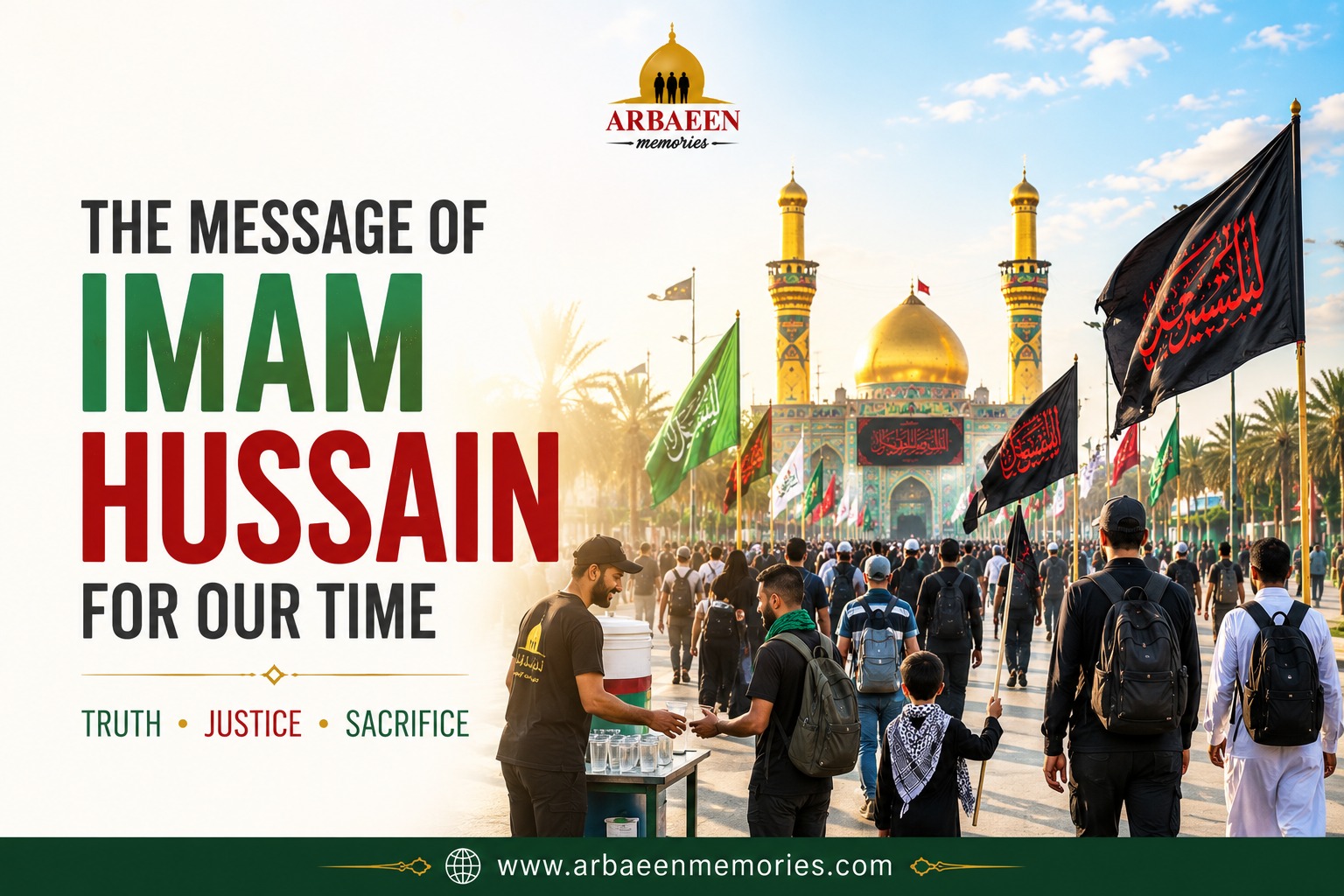
More than 1,400 years ago, on the plains of Karbala, Imam Hussain (A.S.) stood against oppression, injustice, and tyranny.
He refused to compromise his principles, even when faced with overwhelming military power.
His stand was not for:
- Land
- Wealth
- Political authority
It was a struggle to preserve truth, dignity, and justice.
A Message That Remains Relevant
Today, the message of Imam Hussain (A.S.) remains as relevant as ever.
Across the world, millions continue to mourn Karbala not because it is a historical tragedy, but because its lessons continue to unfold in every generation.
The battle between justice and oppression did not end in 680 CE.
It continues wherever:
- Innocent people suffer
- Truth is silenced
- Power is used without accountability
The Humanitarian Crisis in Palestine
In recent decades, the people of Palestine have endured:
- War
- Displacement
- Blockades
- Humanitarian suffering
In Gaza, countless civilians, including women and children, have lost their lives, while many more struggle with shortages of food, water, medicine, and shelter.
Human rights organizations and international agencies have repeatedly raised concerns about the humanitarian crisis facing Palestinian civilians.
The Ongoing Struggles in Yemen
The people of Yemen have also endured years of:
- Conflict
- Economic hardship
- Humanitarian disaster
Millions remain dependent on aid, while children continue to suffer from hunger and malnutrition.
Reports have documented the severe impact that war and airstrikes have had on civilian populations.
The Legacy of Conflict in Iraq and Syria
Iraq and Syria have witnessed decades of:
- War
- Occupation
- Terrorism
- Instability
Hundreds of thousands of civilians have lost their lives, and entire cities have been devastated by conflict.
The human cost has been immense, especially for children who have grown up knowing little except war.
Challenges Faced by Lebanon
Lebanon has also experienced repeated cycles of violence and destruction.
The consequences have included:
- Thousands of deaths
- Large-scale displacement
- Economic difficulties
- Humanitarian challenges
Recent humanitarian appeals reflect the continuing struggles faced by ordinary Lebanese families.
Iran and the Question of Sovereignty
Iran, too, has faced years of:
- Sanctions
- Threats
- Military confrontations
- Attacks
Many Iranians view these pressures as attempts to force political submission and undermine their national sovereignty.
Recent conflicts have further intensified these sentiments.
What Does Karbala Teach Us?
What would Imam Hussain (A.S.) teach us in such times?
His message is not one of hatred.
It is not a call for revenge.
Rather, it is a call to:
- Stand firmly for justice
- Defend the oppressed
- Speak the truth
- Refuse humiliation in the face of wrongdoing
The Choice in Every Generation
In every age there are forces of oppression, and in every age there are people who must choose whether to remain silent or stand for what is right.
Karbala teaches us that true victory is not measured by:
- Military strength
- Political power
- Material advantage
True victory is remaining faithful to justice and truth, regardless of the cost.
A Timeless Inspiration
That is why the message of Imam Hussain (A.S.) continues to inspire millions today.
The names and circumstances may change, but the choice remains the same:
- To stand with justice
- Or to stand with oppression
And for those who follow the path of Karbala, the answer has always been clear.